"Following" – First-Person Psychological Horror Framework
FeaturedA polished Unreal Engine 5 first-person horror engine framework featuring non-volatile multi-tier graphics save states, responsive canvas layout UI, and automated Blackboard AI behavior trees.
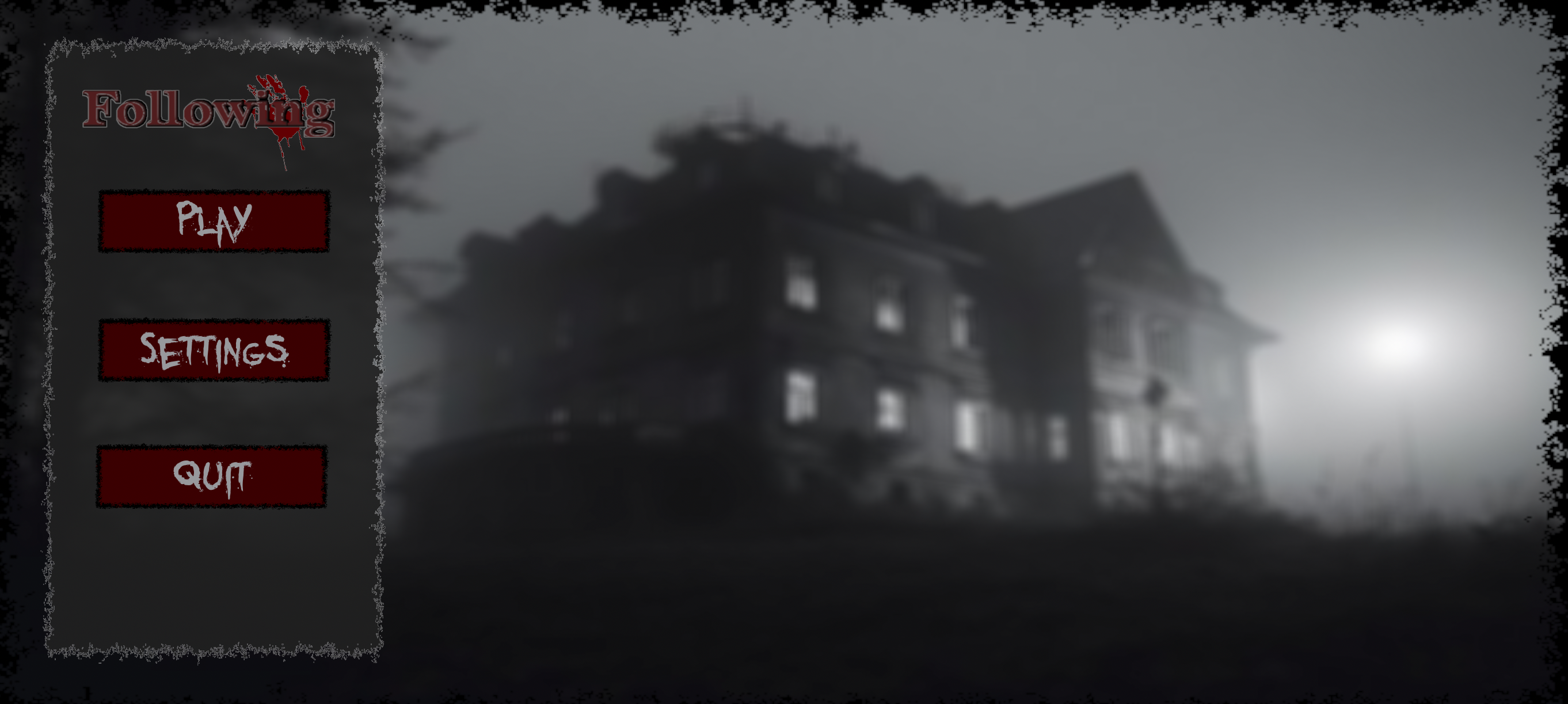
Inspired by classic psychological horror pacing, "Following" is a fully realised first-person survival horror engine prototype developed in Unreal Engine 5. The project serves as a comprehensive technical demonstration of structural game architecture, bridging modular Object-Oriented Programming (OOP) paradigms with dynamic runtime UI scaling and responsive enemy state logic.
The player steps into the shoes of a character navigating a maze of claustrophobic corridors, utilising strict sight-lines, dynamic spatial audio, and restricted visibility to drive tension.
Key Technical Implementations & Engineering Highlights
Scalable Engine Settings Architecture: Engineered a complete, non-volatile graphical user interface save-and-load pipeline utilising Unreal Engine User Settings. Players can scale windowing modes, dynamically switch across five screen resolution indices, and adjust hardware performance metrics (Graphics Scalability and VSync states) at runtime.
Modular Blackboard AI & Behavior Trees: Architected a modular AI sensing and tracking system utilising a dual-state Behavior Tree structure backed by persistent Blackboard keys. The system governs an autonomous actor that seamlessly transitions from an unscripted, random patrol/roam logic loop into an active sensory chase state upon physical line-of-sight pawn detection.
Immersive Audio & Character Pipelines: Configured a custom first-person player controller anchored directly within the character mesh to enforce spatial alignment. Features an interactive toggleable spotlight component and an iterative procedural walk script that uses randomised pitch shifts (
Min -3.0toMax 3.0) on continuous footstep audio cues to eliminate repetitive sounds and maximise acoustic realism.Contextual GUI & Spatial Dialogue Managers: Designed stylised pixel-art UI frames (Main Menu, Settings, Pause, and Escape/Win conditions) utilising optimal responsive canvas anchoring to maintain visual layout integrity across changing hardware aspect ratios. Text and UI layouts are triggered dynamically through spatial collision boxes, displaying clean instructions without fracturing camera immersion.
Software Quality Assurance & Unit Testing
The framework was rigorously validated through a structured unit testing pipeline to evaluate movement fluidness, menu state scaling stability, and AI behavioral loops:
System Persistence: Settings selection profiles successfully applied hardware shifts and persisted accurately across multiple application reboots.
Sensing Verification: The autonomous pawn tracking node passed edge-case testing, reliably initiating tracking updates upon raycast intersection with the player character tag.
Audio Layering: Procedural walk triggers successfully modulated acoustic waves, dynamically shifting pitch properties concurrently with the character's movement velocity.